The cemetery of the old capital Memphis, and the most archaeologically active site in Egypt today — home to the Step Pyramid of Djoser, the Serapeum, and a stream of discoveries that have not stopped since 2018.
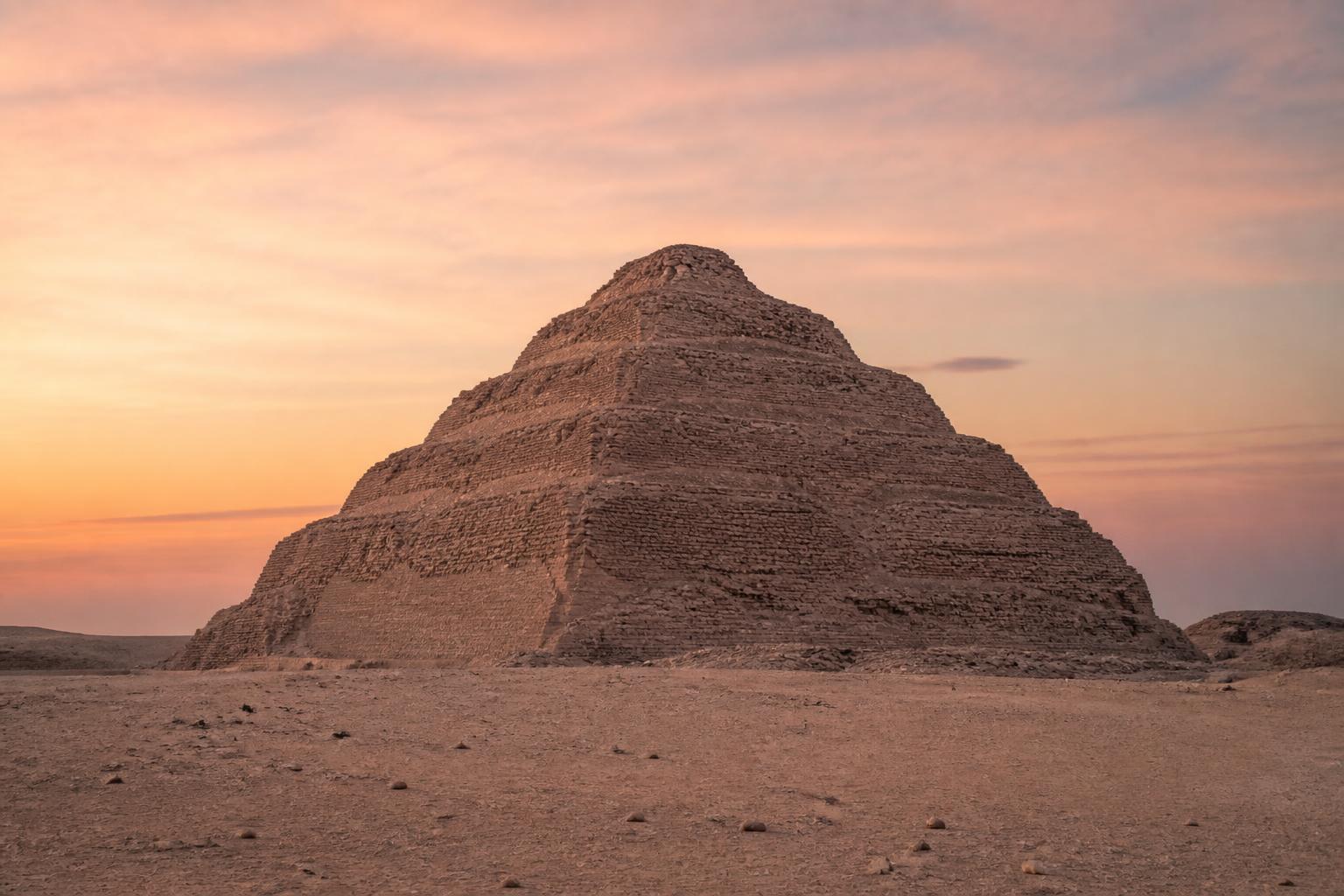
Djoser's Step Pyramid (c. 2670 BCE), designed by Imhotep, was the first monumental stone building anywhere in the world. Every later pyramid descends from it. The surrounding complex — dummy chapels, a Heb-Sed court, a serdab with Djoser's statue still staring out — translates a perishable festival landscape of reed booths and mudbrick into eternal limestone.
Saqqara never stopped being a cemetery. Old Kingdom pyramids cluster at the north and south ends; Sixth Dynasty pharaohs (Teti, Pepi I, Pepi II) inscribed the earliest Pyramid Texts on their burial chamber walls. Then New Kingdom Memphite officials cut tombs into the cliffs — including Horemheb's, made while he was still a general under Tutankhamun and never used.
The Serapeum is the most physically overwhelming experience at Saqqara: a kilometre of rock-cut gallery housing twenty-four granite sarcophagi, each weighing seventy tonnes, made for the mummified Apis bulls regarded as living incarnations of Ptah.
Step Pyramid complex of Djoser
The recently completed restoration has reopened the burial chamber and the South Tomb's stunning blue-tiled corridors — easy to miss without a guide.
Serapeum of the Apis Bulls
Allow forty-five minutes underground. The scale of the granite sarcophagi defeats any photograph; this is one of the few sites in Egypt that genuinely shocks.
Pyramid of Unas
The first pyramid inscribed with the Pyramid Texts, the world's oldest surviving religious literature. The blue-painted hieroglyphs on the burial-chamber walls remain extraordinary.
Mastaba of Mereruka
The largest non-royal Old Kingdom tomb at Saqqara — thirty-three rooms of painted scenes of daily life, fishing, music and force-feeding hyenas.
"Saqqara is, in Chris Naughton's words, the site that 'keeps rewriting itself'. The current Bubasteion concession, led by Mohamed Mostafa Waziri's team and the Saqqara Saite Tombs Project, has opened more than a hundred coffined burials and several intact tombs since 2018 — including the painted shaft of Wahtye, the priest who appears in the Netflix documentary Naughton himself helped narrate the field for."
"Salima Ikram, Distinguished University Professor at the American University in Cairo, has spent decades studying the funerary archaeology of the Memphite necropolis. Her work on animal mummies — including the sacred bulls of the Serapeum — and her on-camera role in Netflix's Secrets of the Saqqara Tomb make her the clearest contemporary voice on what the site's ongoing excavations mean. She reads Saqqara not as a single-period cemetery but as a living landscape of burial that adapted across three millennia."
"Piers Litherland's work in the Theban Western Wadis is reframing how we read royal burial site selection in the early Eighteenth Dynasty, and his methodology — slow, patient survey of overlooked side wadis — is the same logic that has just produced Saqqara's recent harvest. The lesson is that Egypt's 'famous' sites are still largely unexcavated."
"Ramadan Hussein, the late director of the Saqqara Saite Tombs Project (Tübingen), led the team that opened the embalming workshop and shaft complex at the Bubasteion in 2018 — the discovery that reframed Saqqara as a continuing 26th-Dynasty industrial mortuary site, not just an Old Kingdom relic. His protocol of in-situ recording before removal is now the template for the Bubasteion concession."
"Miroslav Bárta and the Czech Institute of Egyptology have worked the Abusir–Saqqara plateau for five decades. Bárta argues that the Fifth- and Sixth-Dynasty mastaba clusters around the southern pyramids record a measurable shift in elite power — provincial governors building tombs that rival the king's. His 'collapse' model for the end of the Old Kingdom is built from the Saqqara/Abusir evidence."
"Zahi Hawass — first as Director of the Giza Plateau, then as Minister of Antiquities — re-excavated the cemetery west of the Step Pyramid and reopened the burial chamber of Djoser after the 2011–2020 restoration. His public framing of Saqqara as 'Egypt's most active dig' has driven the funding behind every recent discovery; whatever one makes of the showmanship, the access he won for foreign missions is real."
The sources behind this entry. Each link opens a Google Scholar search for the work — most have free previews, full PDFs, or library availability.
- Naughton, C. — Egyptologists' Notebooks (2020)
- Litherland, P. — The Western Wadis of the Theban Necropolis (NHBS, 2014)
- Lauer, J.-P. — Saqqara: The Royal Cemetery of Memphis
Also try JSTOR, Academia.edu, and the Egypt Exploration Society.