Karnak
The Atlas

Thebes (Luxor) · Middle Kingdom · New Kingdom · Ptolemaic

Karnak

The temple that two thousand years could not finish

Glance · 60 seconds

The largest religious complex ever built — a city of pylons, obelisks and 134 papyrus columns added to and rebuilt by thirty pharaohs over two millennia, all to house the god Amun-Re.

Context · 5 minutes

Karnak is not one temple but three precincts (Amun-Re, Mut, Montu) stitched together over time. Each pharaoh tried to outdo their predecessor — Hatshepsut raised obelisks, Thutmose III walled them in, Amenhotep III added the Third Pylon, Seti I and Ramesses II built the Hypostyle Hall on top.

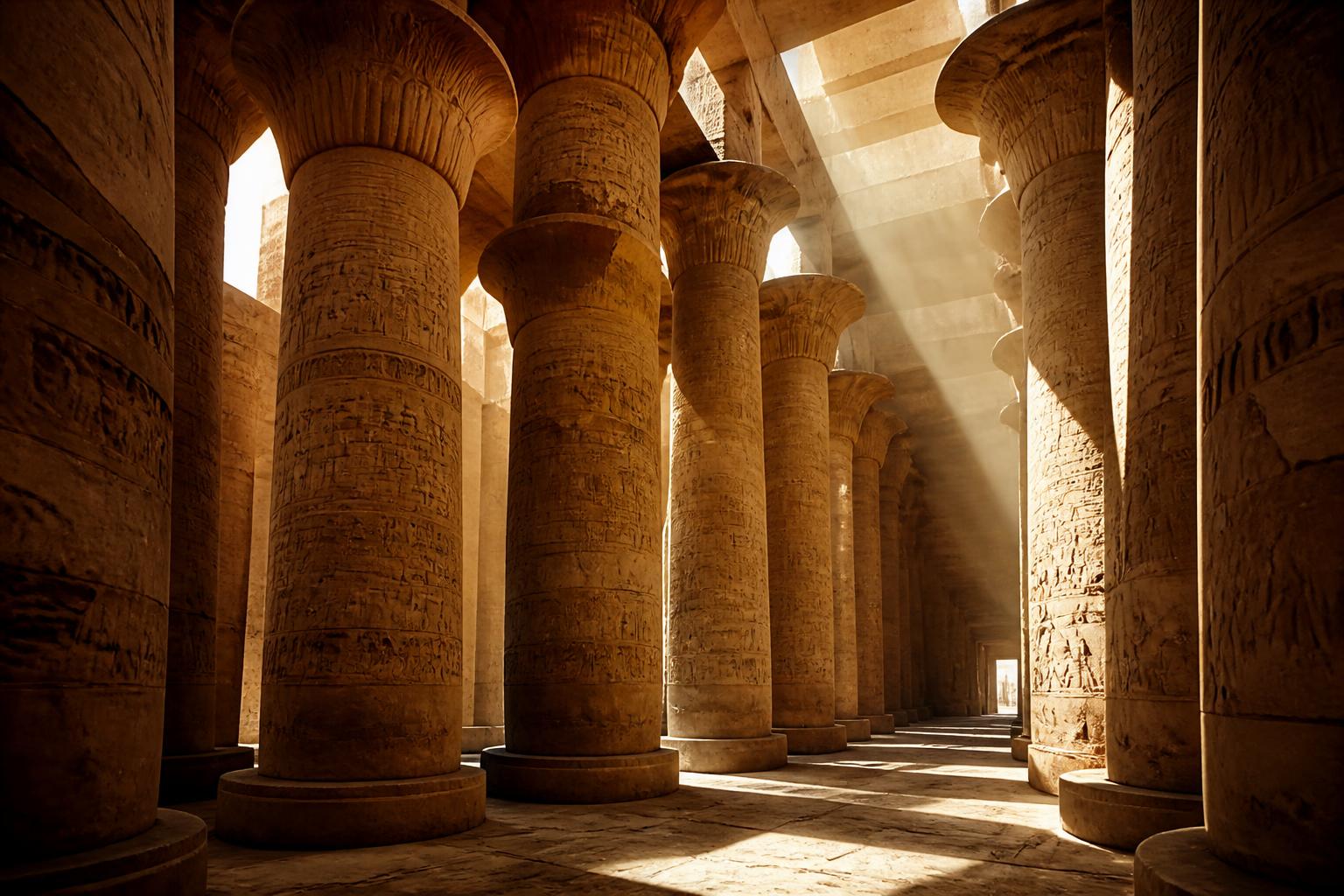
The Hypostyle Hall — 50,000 square feet of forest-dense column — was almost certainly roofed. Imagine the hall as the priests saw it: lit only by clerestory grilles, the columns vanishing upward into smoke and shadow. The bright open ruin you walk today is the consequence, not the design.

The Sacred Lake on the south side is not decoration. Priests bathed there before dawn rituals, and the lake fed the sacred geese of Amun. The temple was a working machine of cult, not a museum.

What to look for

Great Hypostyle Hall

Walk slowly. The central twelve columns are 21 metres high with open papyrus capitals; the flanking 122 have closed bud capitals. Find the painted soffits still bearing original blue and ochre.

Hatshepsut's standing obelisk

29.6 metres of single-piece pink Aswan granite — the tallest ancient obelisk still in place. Her successor Thutmose III walled around it rather than topple it.

Open-Air Museum

The reassembled White Chapel of Senwosret I and the Red Chapel of Hatshepsut, rescued from the Third Pylon's fill. Often empty of visitors and the most rewarding hour at Karnak.

Cachette Court

Where, in 1903, Georges Legrain pulled 779 statues and 17,000 bronzes from a single buried deposit — the largest cache of Egyptian sculpture ever found.

Scholar · 15 minutes
"Chris Naughton has emphasised how much of what visitors see at Karnak is the work of restorers as much as pharaohs — the Hypostyle Hall's standing columns were re-erected in the early twentieth century after a catastrophic collapse in 1899, and the project to reconstruct it accurately is ongoing."
Naughton, Egyptologists' Notebooks (2020)
"John Romer reads Karnak as evidence that 'ancient Egyptian religion' was never static — each generation of priests and kings actively re-negotiated which gods mattered, which festivals were performed, and which earlier monuments were dismantled for fill. The Third Pylon, when excavated, was found stuffed with blocks from Senwosret I's White Chapel and Hatshepsut's Red Chapel — both now reassembled in the Open-Air Museum on site."
Romer, A History of Ancient Egypt, Vol. III (2024)
Further reading

The sources behind this entry. Each link opens a Google Scholar search for the work — most have free previews, full PDFs, or library availability.

Also try JSTOR, Academia.edu, and the Egypt Exploration Society.
On the ground
Loading map…

Keep reading

Other sites in the atlas

Greater Cairo

The Giza Plateau

Khufu, Khafre, Menkaure and the Sphinx

Memphite Necropolis

Saqqara

Three thousand years of burial above Memphis

Greater Cairo

Egyptian Museum (Tahrir)

The 1902 cabinet of wonders on Tahrir Square

Greater Cairo

Grand Egyptian Museum (GEM)

A walk-around guide to the new flagship beside the pyramids

Greater Cairo

NMEC — National Museum of Egyptian Civilization

The Royal Mummies in Fustat

Greater Cairo

Heliopolis (Matariya)

The ancient Iunu, city of the sun

Memphite Necropolis

Memphis (Mit Rahina)

The vanished capital and a recumbent Ramesses

Memphite Necropolis

Dahshur

The Red and Bent Pyramids of Sneferu

Memphite Necropolis

Abusir

The Fifth Dynasty's quiet royal cemetery

Memphite Necropolis

Abu Rawash

Djedefre's lost pyramid

Memphite Necropolis

Lisht

The Middle Kingdom returns to pyramids

Memphite Necropolis

Meidum

Sneferu's first attempt

Fayum

Hawara

Amenemhat III and the lost Labyrinth

Fayum

Lahun (El-Lahun)

Senwosret II's pyramid town

Fayum

Karanis (Kom Aushim)

A Greco-Roman Fayum farming town

Middle Egypt

Beni Hasan

Middle Kingdom rock-cut nomarchs

Middle Egypt

Tell el-Amarna (Akhetaten)

Akhenaten's heretic capital

Middle Egypt

Tuna el-Gebel

The catacombs of Thoth's ibises

Middle Egypt

Hermopolis Magna (Ashmunein)

City of Thoth

Abydos & Dendera

Abydos

The Osireion and the Seti I temple

Abydos & Dendera

Umm el-Qaab

Tombs of the First Dynasty kings

Abydos & Dendera

Dendera

The Ptolemaic temple of Hathor

Thebes (Luxor)

Luxor Temple

Amenhotep III and Ramesses II in the heart of the city

Thebes (Luxor)

Valley of the Kings

Sixty-five royal tombs in a desert wadi

Thebes (Luxor)

Valley of the Queens

Nefertari's painted chamber

Thebes (Luxor)

Deir el-Bahari

Hatshepsut's terraced mortuary temple

Thebes (Luxor)

Medinet Habu

Ramesses III's fortress-temple

Thebes (Luxor)

The Ramesseum

Ozymandias's fallen colossus

Thebes (Luxor)

Deir el-Medina

The workers' village of the Valley of the Kings

Thebes (Luxor)

Tombs of the Nobles

Sheikh Abd el-Qurna and the Asasif

Thebes (Luxor)

Western Wadis (Wadi Sikkat Taqa el-Zeide)

Piers Litherland's Thutmose II discovery

Thebes (Luxor)

Malkata

Amenhotep III's pleasure palace

Thebes (Luxor)

Colossi of Memnon

The seated kings of the West Bank approach

Esna to Aswan

Esna

The Khnum temple sunk below street level

Esna to Aswan

Edfu (Temple of Horus)

The best-preserved temple in Egypt

Esna to Aswan

Kom Ombo

The double temple of Sobek and Haroeris

Esna to Aswan

Gebel el-Silsila

The great sandstone quarry of the Nile

Esna to Aswan

El-Kab

The Predynastic walled town of Nekheb

Aswan & Nubia

Elephantine Island

The southern frontier of Egypt

Aswan & Nubia

Qubbet el-Hawa

The rock-cut tombs of the Aswan governors

Aswan & Nubia

Philae (Agilkia Island)

The last temple of Isis

Aswan & Nubia

Abu Simbel

Ramesses II's cliff facing the rising sun

Delta

Tanis (San el-Hagar)

The silver coffins of the Third Intermediate Period

Delta

Avaris / Pi-Ramesses (Tell el-Dab'a)

The Hyksos capital and Ramesside city

Delta

Bubastis (Tell Basta)

The cat-goddess Bastet's home

Delta

Sais (Sa el-Hagar)

Capital of the Twenty-Sixth Dynasty

Alexandria & Coast

Catacombs of Kom el-Shoqafa

Alexandrian funerary fusion

Alexandria & Coast

Pompey's Pillar & the Serapeum

What's left of the great library's neighbour

Alexandria & Coast

Heracleion / Thonis (Underwater)

Goddio's sunken port

Sinai

Serabit el-Khadim

Hathor of turquoise and the proto-Sinaitic script

Sinai

St. Catherine's Monastery

Sixth-century library at the foot of Sinai

Eastern Desert

Wadi el-Jarf

Khufu's harbour and the oldest papyri in the world

Eastern Desert

Wadi Hammamat

The greywacke quarry of the desert road

Western Desert

Siwa Oasis — Oracle of Amun

Where Alexander asked the question

Western Desert

Bahariya Oasis — Valley of the Golden Mummies

Greco-Roman desert necropolis

Western Desert

Kharga — Bagawat & Hibis

Persian-Egyptian temple and Coptic necropolis

Middle Egypt

White Monastery (Deir al-Anba Shenouda)

Shenoute's fifth-century basilica