The largest archaeological museum in the world — 500,000 m² of alabaster-clad galleries two kilometres from the Giza plateau, anchored by Tutankhamun's complete tomb assemblage (5,400 objects shown together for the first time) and Khufu's reassembled 4,600-year-old cedar solar boat. Plan a full day; serious visitors plan two.
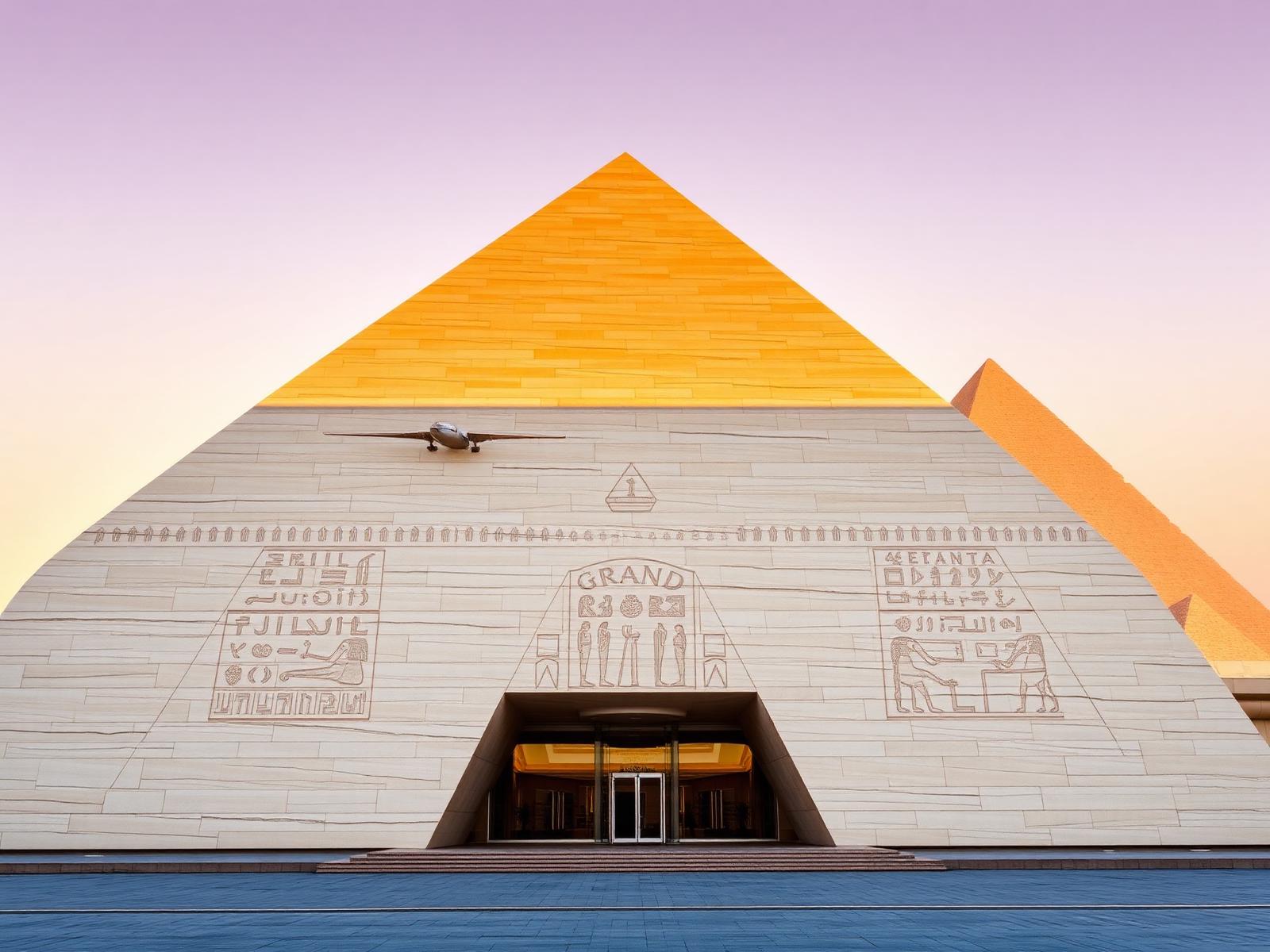
The building itself is the first exhibit. Heneghan Peng's competition-winning design (2003) sets a 600-metre alabaster facade against the desert escarpment, its triangular geometry mirroring the pyramids two kilometres away. Stand on the upper terrace at sunset and the three pyramids align with the museum's central axis — this is intentional, not accident.
GEM opened in stages between 2023 and the full inauguration in November 2025, more than two decades after groundbreaking. It absorbs collections previously scattered across Tahrir, the old Cairo Museum, regional storerooms and the Solar Boat Museum on the Giza plateau — and presents many objects for the first time in proper climate-controlled, low-light, contextual display.
The Tutankhamun galleries on Level 2 are the headline. For a century only about a third of the tomb assemblage was on permanent view at Tahrir; here all 5,400 objects are reunited in the original layout of the four chambers, with chariots, beds, gloves, sandals and food jars restored to their relationships. It is the closest anyone has come to standing in the tomb since Howard Carter closed it in 1932.
1. Atrium — the Ramesses II colossus
Begin here. The 11-metre, 83-tonne red granite statue of Ramesses II, rescued from a Cairo traffic island in 2006 and moved 30 km to the museum in a televised national event, anchors the entrance hall. Walk a full circle: the back-pillar inscription names his father Seti I.
2. The Grand Staircase
Six storeys of ascending ramp lined with 87 monumental pieces — sarcophagi, obelisks, royal statuary — arranged chronologically as you climb. At the top, a panoramic window frames the Giza pyramids on axis. This is the museum's single best photograph; arrive before 10:00 for clean light.
3. Main Galleries — Levels by era
Twelve galleries, four eras (Prehistory to Old Kingdom; Middle to New Kingdom; Late to Greco-Roman), three themes per era (Society, Kingship, Beliefs). Don't try to read every label. Targets: the Narmer Palette replica with its original context (the real one stays at Tahrir for now), the Khufu ivory statuette (the only certain portrait of the Great Pyramid's builder, 7.5 cm tall), and the Hatshepsut head from Deir el-Bahri.
4. Tutankhamun Galleries (timed entry)
Allow 90 minutes minimum. The galleries reconstruct the Antechamber, Burial Chamber, Treasury and Annexe in their original spatial sequence. Look for: the painted wooden chest with hunting scenes (one of the finest paintings to survive from antiquity), the second coffin (gilded wood, never displayed before 2024), the alabaster canopic shrine, and the recently re-restored ceremonial chariot. The gold mask is the climax — kept in a separate darkened room with a queue management system.
5. Khufu's Solar Boat
A purpose-built pavilion houses the 43.6-metre cedar vessel disassembled and buried beside the Great Pyramid c. 2570 BCE, rediscovered in 1954 by Kamal el-Mallakh, and reassembled at GEM after a multi-year move from its old plateau museum. Walk the full three-level circuit; the upper gallery shows the boat from above, the lower gallery places you at hull height. The second boat, still partly disassembled, is displayed nearby with the original timber crates.
6. Children's Museum and Conservation viewing window
On the lower level, often missed. The conservation lab has a public viewing gallery where you can watch conservators working on actual objects — usually textiles or wooden coffins. Sign-language and tactile tours run on Fridays.
7. The Commercial Plaza and rooftop
Save energy for the exit. The plaza level has the only serious restaurant on site (Khufu's, panoramic pyramid view, book ahead) and a bookshop with the strongest Egyptology selection in Cairo. The upper terrace at sunset is free to access without a re-entry ticket.
"Tarek Tawfik, GEM's former Director-General, has described the museum's curatorial ambition as a deliberate corrective to the Tahrir model: not a typological cabinet of trophies but a chronological, thematic narrative running from the Predynastic to the Greco-Roman, with the Tutankhamun assemblage held back as a destination rather than a centrepiece. The visitor walks Egyptian history before meeting its most famous boy-king."
"Chris Naughton has noted that GEM also resolves a long-running conservation crisis: many of Tutankhamun's organic objects — textiles, leather, the ceremonial chariots — were deteriorating in Tahrir's uncontrolled environment. The Grand Egyptian Museum Conservation Centre, attached to the galleries, has been quietly stabilising the collection since 2010 and is the largest archaeological conservation lab in the world."
The sources behind this entry. Each link opens a Google Scholar search for the work — most have free previews, full PDFs, or library availability.
- Heneghan Peng Architects — Grand Egyptian Museum competition documentation (2003)
- Tawfik, T. — published lectures on GEM curation, 2018–2024
- Ikram, S. — Tutankhamun's Tomb: The Thrill of Discovery (AUC Press, revised 2023)
- Naughton, C. — Egyptologists' Notebooks (Thames & Hudson, 2020)
Also try JSTOR, Academia.edu, and the Egypt Exploration Society.