
KV62
Tutankhamun
The only virtually intact royal burial. Small chamber, gilded shrines now in GEM; the mummy and the painted burial chamber remain in situ.
Thebes · West Bank · New Kingdom
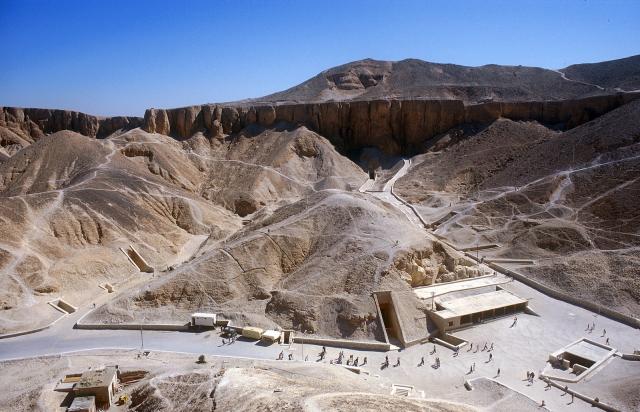
tA st aAt — "The Great Place". Sixty-five numbered tombs cut into a single desert wadi opposite Luxor, beneath the natural pyramid of the Qurn.
This page draws extensively on the Theban Mapping Project — Kent Weeks's American Research Center in Egypt initiative that has surveyed every KV tomb since 1980 and remains the definitive open source for the Valley. Every tomb image and link below points back to their record.
Interactive Map
A schematic plan of the Valley after the Theban Mapping Project atlas. The East Valley (right) holds almost every tomb tourists visit; the West Valley (left) is the quieter side, with only Amenhotep III (KV22) and Ay (KV23). Zoom in to read the labels, drag to pan, tap any marker to see who lies inside and jump to its full TMP record.
Schematic plan after the Theban Mapping Project atlas. Positions are approximate and intended for orientation, not survey-accurate measurement.
What you can actually visit
A standard ticket opens three tombs from a rotating set; the supplements for Seti I (KV17), Tutankhamun (KV62) and Rameses V/VI (KV9) are well worth paying. The Luxor Pass Premium covers every open tomb in the Valley.
KV62
The only virtually intact royal burial. Small chamber, gilded shrines now in GEM; the mummy and the painted burial chamber remain in situ.

KV17
The longest, deepest and most ambitious royal tomb. Astronomical ceiling and complete Book of Gates. Premium ticket only.

KV9
Probably the most spectacular painted ceiling in the Valley — the double Book of the Day and Night with the body of Nut spanning the whole burial chamber.

KV11
Wide, well-lit corridors with the famous 'harpers' scenes and side-chamber reliefs of trade goods and foreign tribute. Excellent for non-specialists.

KV2
Short and very accessible; vivid blue ceiling and a giant pink-granite sarcophagus still in place. Often the calmest tomb in the Valley.

KV8
The second-longest tomb in the Valley. Two nested granite sarcophagus lids remain in the burial chamber — staggering scale.

KV34
Cut high in a cleft; reached by a metal staircase. Cursive 'papyrus-on-stone' Amduat in the oval burial chamber — the earliest fully decorated KV tomb.

KV57
Unfinished decoration captured mid-process: gridded ink drawings beside fully carved and painted scenes. A masterclass in how the tombs were made.
Excavation History
1799
Napoleon's savants map the visible tomb entrances; about 25 are known.
1816–17
Giovanni Belzoni clears eight tombs, including KV17 (Seti I) — the longest then known.
1827
John Gardner Wilkinson paints the KV numbers we still use, working from the entrance southward.
1898
Victor Loret finds sixteen tombs and the royal mummy cache in KV35 (Amenhotep II).
1902–14
Theodore Davis sponsors 13 seasons; 35 tombs cleared. His excavator: Howard Carter.
1922
Carter and Carnarvon open KV62 — Tutankhamun. The only virtually intact royal burial ever found in the Valley.
1978–80
John Romer (Brooklyn Museum) records KV4, Rameses XI — the last royal tomb cut in the Valley.
1980–present
The Theban Mapping Project (Kent Weeks, AUC) maps every KV tomb. In 1995 the team rediscovers KV5: 120+ chambers for the sons of Rameses II.
2005
Otto Schaden finds KV63 — an embalming cache, the first 'new' KV tomb since Tutankhamun.
2011
KV64 located by the Basel team — a 22nd-Dynasty reuse burial of a Chantress of Amun.
2025–
Zahi Hawass announces a tentative KV65 in the West Valley; excavation ongoing.
Conservation
The Valley is a natural drainage funnel. Catastrophic floods in 1916, 1994 and 1995 sent water cascading into KV5, KV13, KV14 and KV15. Concrete deflection walls and tomb-entrance shelters are now standard.
Each visitor exhales moisture; multiply by 5,000 a day in KV62 and the paint surface salts every season. Tombs now rotate open/closed, plexiglass panels protect walls, and KV62 has an active air-circulation system installed by the Getty Conservation Institute.
The Esna shale layer beneath the limestone swells when wet. The TMP has been monitoring crack propagation above KV5 and KV7 (Rameses II) for thirty years — the slowest, most decisive threat.
The Kings, in Order
Five centuries of New Kingdom rulers, listed chronologically with regnal dates and a direct link to each tomb's record on the Theban Mapping Project.
18th Dynasty · c. 1504–1492 BC
First king buried in the Valley. Later moved by Thutmose III.
Tomb KV38
KV38Open tomb18th Dynasty · c. 1479–1458 BC
Re-cut her father's tomb to lie beside him.
Tomb KV20
KV20Open tomb18th Dynasty · c. 1479–1425 BC
Earliest fully decorated tomb — cursive Amduat.
Tomb KV34
KV34Open tomb18th Dynasty · c. 1427–1400 BC
Held the royal mummy cache discovered by Loret, 1898.
Tomb KV35
KV35Open tomb18th Dynasty · c. 1400–1390 BC
Tomb KV43
KV43Open tomb18th Dynasty · c. 1390–1352 BC
West Valley. Father of Akhenaten.
Tomb KV22
KV22Open tomb18th Dynasty · c. 1336–1327 BC
Only virtually intact royal burial. Carter, 1922.
Tomb KV62
KV62Open tomb18th Dynasty · c. 1327–1323 BC
West Valley. Successor of Tutankhamun.
Tomb KV23
KV23Open tomb18th Dynasty · c. 1323–1295 BC
Decoration captured mid-process.
Tomb KV57
KV57Open tomb19th Dynasty · c. 1295–1294 BC
Founder of the 19th Dynasty; very short reign and small tomb.
Tomb KV16
KV16Open tomb19th Dynasty · c. 1294–1279 BC
Longest, deepest, most ambitious tomb in the Valley.
Tomb KV17
KV17Open tomb19th Dynasty · c. 1279–1213 BC
Ruined by ancient floods; his sons lie opposite in KV5.
Tomb KV7
KV7Open tomb19th Dynasty · c. 1213–1203 BC
Second-longest tomb; two nested granite sarcophagus lids remain.
Tomb KV8
KV8Open tomb19th Dynasty · c. 1203–1200 BC
Tomb KV10
KV10Open tomb19th Dynasty · c. 1200–1194 BC
Tomb KV15
KV15Open tomb19th Dynasty · c. 1194–1188 BC
Tomb KV47
KV47Open tomb19th Dynasty · c. 1188–1186 BC
Tomb later usurped and extended by Setnakht.
Tomb KV14
KV14Open tomb20th Dynasty · c. 1186–1184 BC
Took over Tausret's tomb; founder of the 20th Dynasty.
Tomb KV14
KV14Open tomb20th Dynasty · c. 1184–1153 BC
The 'harpers' tomb. Killed in the harem conspiracy.
Tomb KV11
KV11Open tomb20th Dynasty · c. 1153–1147 BC
Vivid blue astronomical ceiling; great pink granite sarcophagus.
Tomb KV2
KV2Open tomb20th Dynasty · c. 1147–1143 BC
Buried in his uncle Rameses VI's tomb.
Tomb KV9
KV9Open tomb20th Dynasty · c. 1143–1136 BC
Spectacular Book of Day & Night ceiling — body of Nut spanning the chamber.
Tomb KV9
KV9Open tomb20th Dynasty · c. 1136–1129 BC
Tomb KV1
KV1Open tomb20th Dynasty · c. 1126–1108 BC
Visible from the main entrance — usually open.
Tomb KV6
KV6Open tomb20th Dynasty · c. 1108–1099 BC
Tomb KV18
KV18Open tomb20th Dynasty · c. 1099–1069 BC
Last royal tomb cut in the Valley; never used for the burial.
Tomb KV4
KV4Open tombThutmose II's tomb is uncertain (a candidate was announced in the Western Wadis in 2025). Akhenaten was buried at Amarna, not here.
Full Tomb Index
Most are closed to visitors — many are little more than pits or unexcavated shafts — but every one is mapped and recorded by the TMP. Click any tile for the full TMP record, plans and photo archive.

KV1
Rameses VII
KV2
Rameses IV

KV3
Son of Rameses III

KV4
Rameses XI

KV5
Sons of Rameses II

KV6
Rameses IX

KV7
Rameses II
KV8
Merenptah
KV9
Rameses V & VI

KV10
Amenmeses
KV11
Rameses III

KV12
Unknown

KV13
Bay

KV14
Tausert & Setnakht

KV15
Seti II

KV16
Rameses I
KV17
Seti I

KV18
Rameses X

KV19
Mentuherkhepeshef

KV20
Thutmose I & Hatshepsut

KV21
Unknown (two queens)

KV22
Amenhotep III

KV23
Ay

KV24
Unknown

KV25
Unknown

KV26
Unknown

KV27
Unknown

KV28
Unknown

KV29
Unknown
KV30
Unknown
KV31
Unknown

KV32
Tia'a
KV33
Unknown
KV34
Thutmose III

KV35
Amenhotep II
KV36
Maiherperi
KV37
Unknown

KV38
Thutmose I

KV39
Amenhotep I (?)
KV40
Unknown

KV42
Hatshepsut-Meryet-Ra

KV43
Thutmose IV

KV44
Unknown

KV45
Userhat
KV46
Yuya & Thuyu

KV47
Siptah

KV48
Amenemipet

KV49
Unknown

KV50
Animal tomb (baboon, birds)

KV51
Animal tomb (baboon, dog)
KV52
Animal tomb (baboon)
KV53
Unknown

KV54
Tutankhamun embalming cache

KV55
Tiye (?) or Akhenaten (?)

KV56
'The Gold Tomb'
KV57
Horemheb

KV58
Unknown
KV59
Unknown
KV60
Sit-Ra, called In (?)
KV61
Unknown
KV62
Tutankhamun

KV63
Unknown (embalming cache)
KVA
Unknown
KVF
Unknown
KV64 (2011, Basel team) and KV65 (under excavation by Hawass, West Valley) are not yet published on the TMP site.